
CHOICE OF LANGUAGE (FR/EN/NO/SV/DE/PL):
CHOICE OF LANGUAGE (FR/EN/NO/SV/DE/PL):
14 octobre 2026
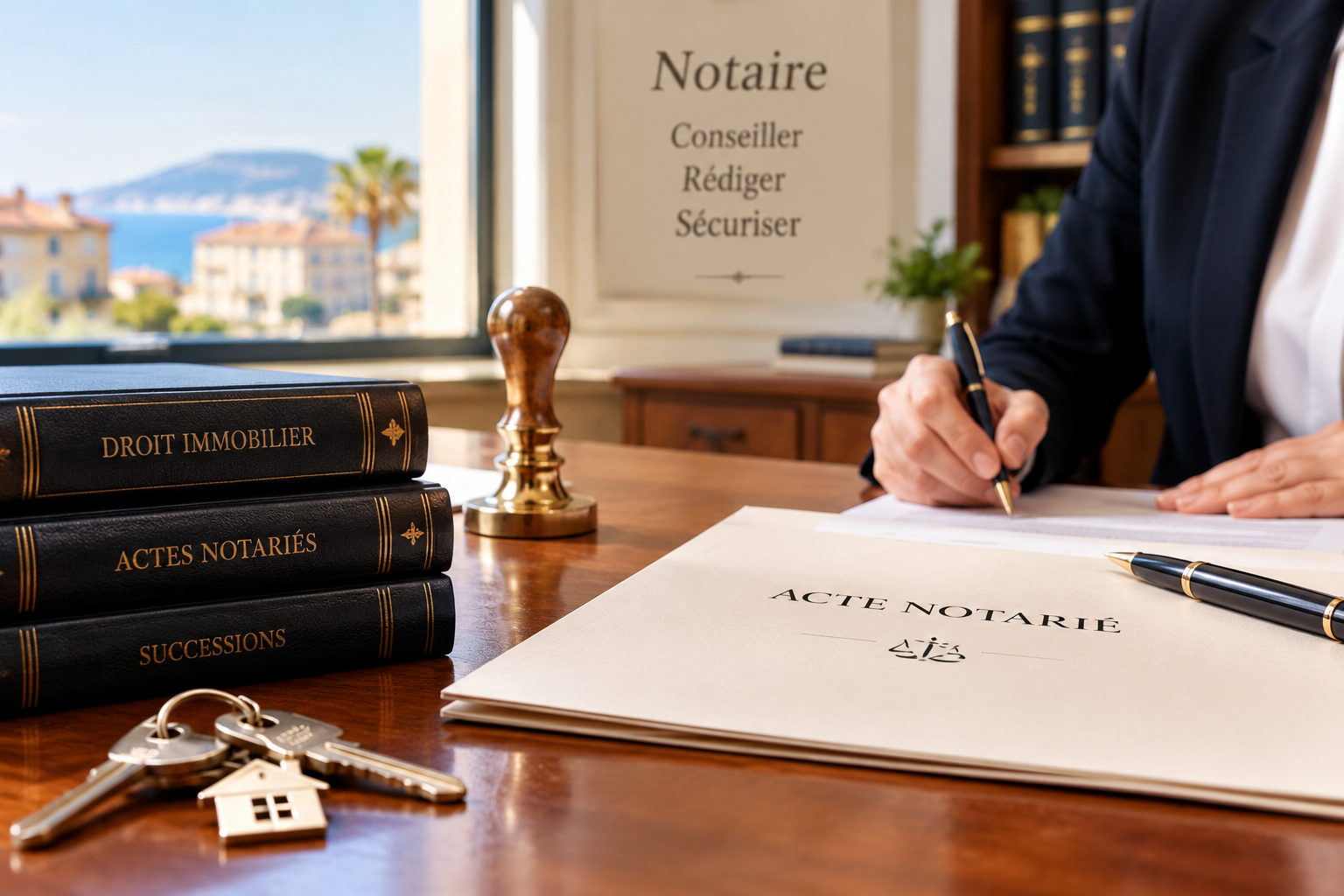
In a French property transaction, a notaire is essential. The notaire is a public official with responsibility for ensuring that property transactions comply with French law and that the transfer of ownership is legally secure.
The notaire is a highly qualified legal professional (7-8 years of studies), appointed by decree by the French ministry of Justice and operating a private practice. The role is quite different from that of a conventional lawyer: the notaire is expected to remain impartial and does not act exclusively for either the buyer or the seller. And yes, you can have two. The buyer and seller may each appoint their “own” notaire. The two notaires then work together on the transaction, with the fees divided between them. Equally, there is nothing unusual about using a single notaire who handles the transaction impartially for both parties.
The profession has a remarkably long history having existed in France many centuries. This said, it took quite some time for the notaire to enter the digital age; But electronic signatures, digital document management and remote meetings have gradually transformed the process, in part, thanks to the Covid-years clearly contributing to accelerating the transition that was underway.
There has also been a significant structural change. For generations, the number and location of notarial offices were strictly regulated. In 2015 and in 2025, President Macron introduced legislation providing greater freedom for the creation of new offices (lottery system!), gradually opening the profession to more competition.
Whether notaires welcomed this transformation or not, one thing has changed: property buyers and sellers increasingly look—and expect—to be treated as clients rather than as people patiently waiting for their documents to be stamped. We would not go so far as to say that the notaires have discovered customer service. But after 25 years in the business, we can certainly say that the attitude has changed for the better! They nowadays even ask for Google reviews!
The process is broadly divided into two stages. Once a price has been agreed, the first step is the compromis de vente, the preliminary sales agreement. This can be prepared by the real estate agent or by the notaire, depending on the circumstances and the parties' preference. The agreement records the price, the conditions of the sale, the deposit and other important contractual provisions. For a private buyer, a 10-day statutory cooling-off period then applies. Meanwhile, the legal and administrative checks begin.
The second stage is the signing of the acte authentique, the definitive deed of sale. Before this can happen, the notaire carries out extensive investigations: ownership and title, mortgages, planning and building matters, rights of way and easements, property taxes, required certificates, and various regulatory and anti-money-laundering checks. Once all conditions have been satisfied and the purchase funds and taxes have been received, the deed is signed and ownership is transferred to the buyer. The transaction is then registered with the French Land Registry. It may sound bureaucratic. It is.
“Notaire fees” is a rather misleading expression. For an existing property, buyers should generally budget around 7–8% of the purchase price for acquisition costs. However, the notaire does not pocket anything close to this amount (less than 1%). The majority consists of government taxes, registration duties, local taxes, land-registration charges and other statutory costs. For most new-build properties, the overall acquisition costs are considerably lower (approx. 2,5%).
The notaire's remuneration is strictly regulated by the French State and is nationally standardised. So when someone says, “The notaire is charging me 8%!”, the notaire can reasonably reply: “I wish!”
The French property process can appear formal, slow and bureaucratic—particularly to buyers accustomed to more streamlined systems elsewhere. Yet the same bureaucracy provides a considerable degree of legal security.
The impartiality of the notaire, combined with extensive checks before completion, creates a robust system of verification. For international buyers in particular, this can be extremely reassuring: you are not simply signing a contract and hoping everything is fine. Someone has checked. And checked again. But beyond this, there is more than meets the eye…
As a French-Scandinavian real estate team, we work closely with hand-picked, English speaking, modern notaires in Nice, Antibes and Cannes. Finding the right properties for sale is only part of buying on the Côte d'Azur. Understanding how to organise ownership can be just as important.
Should the apartment for sale or one of the houses and villas on the French Riviera be bought personally, jointly, through a company? What about children, inheritance, taxation or a future resale? This is an area where the notaire is formally the right person to advise you. Yet it is a subject that is seldomly discussed in sufficient depth before you decide to buy with AAA. Why? Because detailed ownership planning requires time and such advice is generally not allotted much time or attention by many notaires.
This subject is furthermore often neglected by real estate professionals. It is here we can help—not by replacing the notaire, but by making sure you understand the options, the pros and cons of each solution and to have you ask the right questions before you get to the notaire's desk.
We can give you an initial overview of the issues, explain the different factors that may influence the choice of ownership structure, and help you understand what should be discussed with your notaire. Think of it as our little secret service. Not secret, really, but definitely confidential.
This site is protected by reCAPTCHA and the Google Privacy Policy and Terms of Service apply.